Is Non-Endorsement the same as Demanding Lawful Money?

Collapse
X
 
  • Time
  • Show
Clear All
new posts
  • Unknown
    Junior Member
    • Feb 2012
    • 10

    #1

    Is Non-Endorsement the same as Demanding Lawful Money?

    This is one of many questions that I have because this is confusing me as I have gotten different answers.

    When I first heard about this remedy, it was advised to make a stamp to put on the back of your checks that says:

    DEPOSIT FOR CREDIT ON ACCOUNT OR
    EXCHANGE FOR NON-NEGOTIABLE FEDERAL
    RESERVE NOTES OF FACE VALUE
    ACC#:________________________

    And I just got the stamp in the mail

    However, now that I found this site, I am hearing that it should've been:

    REDEEMED LAWFUL MONEY
    PURSUANT TO 12 U.S.C. SS 411

    My question: is there a specific/appropriate time to use each one, is one better than the other, or do they both serve the same purpose?

    One answer that I have received is that I would want to have TWO stamps, the former being to stamp on the back of the check, and the
    latter to stamp on the memo/signature line on withdrawal slips.

    Personally, I really don't care what they do with my money on the back end, whether they lend it out or not. I just want my demand for
    lawful money to be on record. So would it make sense to just get the latter stamp and use it for withdrawal slips?

    For example:

    Scenario 1:

    Instead of depositing the whole check, I cash part of it and deposit the rest and fill out the form like this:


    Scenario 2:

    When depositing the check, I stamp on the back the "instructions/endorsement":


    Scenario 3:

    Any time after I deposit the check, and I make a withdrawal, to do it like this:


    Should I just do all three, or would one cover the others?
  • David Merrill
    Administrator
    • Mar 2011
    • 5950

    #2
    There are some different approaches.

    That is terrific that you redeem lawful money. One fellow, who is not a suitor (yet) shared with me that he has notified the Fed bank closest to him and carries a card to the bank. Every transaction for cash the tellers make a big ceremony about getting the lawful money for him. It is fun notice.
    www.lawfulmoneytrust.com
    www.bishopcastle.us
    www.bishopcastle.mobi

    Comment

    • Unknown
      Junior Member
      • Feb 2012
      • 10

      #3
      I haven't actually done this yet, though image manipulation software can make it easy to retroactively go back and "stamp" your records of deposit, but that is done privately and only YOU know about your demand. Is it therefore necessary that your "demand" needs to be on public record, or at least witnessed by your financial institution?

      Haha, I might just be cynical, but that almost sounds like the bank tellers are mocking him in a way.

      Comment

      • American_National
        Junior Member
        • Jan 2012
        • 26

        #4
        Actually, it is me who makes it a pleasant experience for the tellers involved in these transactions. I either show my green card concurrent with my transactions, or lay it flat at the teller window in plain view between me and the teller so they know it is there. Initially they will read both sides of the laminated card (the back side contains 12 USC 411 for reference), but after that - they know what it's about and what I am doing - and we have some fun with the transactions.

        I would recommend keeping the burden of documenting the "Lawful Money only" character of the transaction where it belongs, which is upon the financial institution conducting the transaction, though . . . . you will avoid a lot of future conflict in sticking with this approach.

        We can only control our actions, and not the actions of any other party in this regard.

        We do not have any influence or control over what federal reserve or treasury regulations apply to the financial institution's operations.

        We do not have any influence or control over what internal policies or procedures they have implemented to document such transactions.

        We do not have any influence or control over the Department of the Treasury in how such transactions are to be handled or reported.

        We do not have any influence or control over the State Attorney General's Office in their investigations regarding the settling of various types of commercial transactions.

        We do not have any influence or control over the State's Banking regulatory commission and any policies that may govern how such transactions are to be conducted.

        We do not have any influence or control over the Federal Reserve District's policies or procedures established to segregate such transactions as being outside their system.

        By regulation (12 USC 411) we DO have control over making our demand for Lawful (Public) Money of Exchange, [United States currency Notes], a.k.a. "the emergency currency of the United States of America" known.

        We are required to do nothing beyond making our demand known. . . so how can we make our demand well known? Let me give you a practical example of how this could be accomplished.

        I make my demand known in the public records repository via the Clerk of Court, public records section - and they remain a trustee/custodian of my Notice and Demand for my benefit. The local financial institutions fall under the direction and control of this county court system, and are subordinate to it's orders.

        I make my demand known within the Federal Reserve System via this District's branch office that services financial institutions within this area where I live via a notary witnessed 3rd party certificate of service mailing, via certified mail, return receipt via PS Form 3811 as proof of delivery. This Federal Reserve District, and it's branch offices interface with the Department of the Treasury as well as the local member institutions who handle their private credit FRN's. They remain a federal reserve system trustee/custodian of my Notice and Demand for my benefit until such time as I choose to replace the existing notice and demand with another one, or withdraw the existing one - at my discression.

        Federal Reserve System District offices are established to support the operations of financial institutions in their service area who handle their private credit FRN's. Therefore these district offices maintain an authoritative/controlling relationship to the area institutions who handle their private commercial paper notes. They serve as a document repository custodian that establishes my demand within the federal reserve system for the benefit of their sister districts, the Department of the Treasury, and the local financial institutions within their service area. Through a simple one page letter, we inform our local financial institution of our Notice/Demand being in the public record at the county courthouse as well as on record at their local Federal Reserve District branch office, and recommend that they review the public record Notice/Demand and take whatever actions are necessary in accordance with applicable regulations and their local policies/procedures to annotate their account records to reflect the "lawful money only" character of our transactions at their financial institution.

        My 3rd layer of demand is covered locally with a hand-held laminated GREEN card which accompanies me in every transaction performed at any financial institution.

        This demand is handled via the following language on a laminated GREEN card:

        Any transactions, deposits, or withdrawals, hereinafter called
        "Events", are made at this financial institution with the intent
        to handle or receive lawful money only. Events include, but are
        not limited to, deposits, cash withdrawals, payments, or any
        other type of transactions conducted with your financial institution
        including the use of various types of bank cards. Said events are
        subject to our superseding NOTICE AND DEMAND FOR LAWFUL MONEY
        as is historically recorded in the public record within the cognizance
        of the United States, and was placed in record with the express intent
        to redeem any private credit instrument into lawful money pursuant to,
        albeit absent any benefit from, Title 12 Section 411 of the United
        States Code.

        Please make whatever annotations are currently required by regulations
        and/or current policies relating to your financial institution to
        document the “lawful money only” character of this transaction at
        this time.
        THANK YOU!!!

        It is the teller's job to properly annotate the "lawful money only" character of the current transaction in such a manner as to not interfere with their internal policies and procedures established to streamline the prompt settlement of these promise to pay transaction instruments between banking institutions.

        For an optional/enhanced level of transaction documentation - Your deposit slips and/or receipts could be stamped with your "A regular deposit of Lawful Money as credit of like money to account" for the deposit slip, or "This is a 12 USC 411 Lawful Money Transaction" for the deposit receipts via a stamper at the teller window immediately upon the teller giving it to you upon completion of their part of the current transaction. Currently, the banks don't favor using deposit slips in such transactions, but they always give back deposit receipts to confirm the transactions which can be stamped at the teller window prior to concluding your business with the teller. Your business with the teller is not complete until such time as you depart from their teller window.

        I do not do anything to potentially interfere with their internal operations previously established to handle and process such transactions.

        Isn't it the Dept. of the Treasury's/Attorney General's/Federal Reserve District's job to ensure financial institution compliance to procedures in this regard?

        Through using the above approach, who must the Treasury/FED/Atty General/etc. hold accountable for any failure to properly document the nature of the transaction . . . You, or the financial institutions given the lawful money transaction notices as is written about above?

        Which party actively engages in pooling funds to support fractional reserve banking practices . . . You, or the financial institution?

        Who is obligated by positive law to segregate lawful money amounts from funds that can be allocated/accumulated for fractional reserve banking practices i.a.w. 31 USC 5115(b)(2) . . . You, or the financial institution?

        Do we remain free of any potential conflict occurring between ourselves and the financial institutions through the use of this approach and method?

        "This is a lawful money transaction. We do not want any of that fake unlawful money or illegal money in this transaction. We especially do not want any of that counterfeit legal tender mixed up with our lawful money today . . . You do test for counterfeit legal tender, don't you? Could you ensure that we only get the good lawful money stuff given to us in this transaction today, please? Thanks! " :-)

        Matthew 10:16 Behold, I send you forth as sheep in the midst of wolves: be ye therefore wise as serpents, and harmless as doves.
        Last edited by American_National; 02-28-12, 04:47 PM. Reason: added typical bank dialog at the end . . .

        Comment

        • David Merrill
          Administrator
          • Mar 2011
          • 5950

          #5
          Thank you for sharing - American National!

          This is a newer rendition of the Notice to the Federal Reserve Bank.


          Notice to Teller.
          Notice to Teller Backside.


          That said, here is an interesting excursion about admiralty jurisdiction:

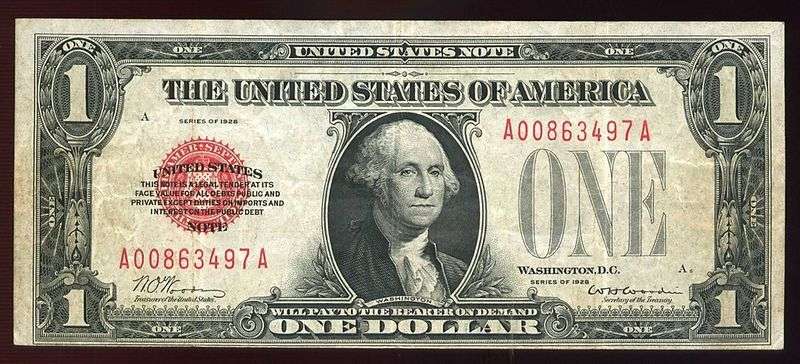
          1928 Federal Reserve Note.
          1928 United States Note.

          Notice the limitations on the US Note for INTEREST ON THE PUBLIC DEBT and for paying DUTIES ON IMPORTS!

          That says a lot.
          Last edited by David Merrill; 02-28-12, 05:14 PM.
          www.lawfulmoneytrust.com
          www.bishopcastle.us
          www.bishopcastle.mobi

          Comment

          • Jethro
            Member
            • Apr 2011
            • 87

            #6
            Originally posted by David Merrill View Post

            That said, here is an interesting excursion about admiralty jurisdiction:

            1928 Federal Reserve Note.
            1928 United States Note.

            Notice the limitations on the US Note for INTEREST ON THE PUBLIC DEBT and for paying DUTIES ON IMPORTS!

            That says a lot.
            David, could you please explain the admiralty jurisdiction connection in relation to FRN's and/or commercial paper?

            Comment

            • David Merrill
              Administrator
              • Mar 2011
              • 5950

              #7
              Originally posted by Jethro View Post
              David, could you please explain the admiralty jurisdiction connection in relation to FRN's and/or commercial paper?
              Gladly! It is so simple though, that you might find it difficult to follow unless you have made the excursion in your true name, into the admiralty to exercise your remedy from the same in the name of the (state) districts.

              Libel of Review.

              The Constitution is elementary and admiralty document. Thirteen different nations looked outside themselves for an international unification - the United States of America. That may not be so obvious until you look at the Judiciary Act of 1789 specifically at Chapter 20 forming the Article III judiciary. It is in this Act that we find the districts are created in the States and we find our website namesake for the remedy 'saving to suitors' from automatic default into admiralty jurisdiction.

              Look what happened in 1790, nearly a year later:


              Note the summary notation for the bottom paragraph - duties on imports.

              That is the distinction between the 1928 bills. Look at what the FRN is good for but the limitations on the US note:


              The US note cannot be used for a reserve currency. Check out . It may be coming clear to you by now. Another way of saying it is that the obligations of the US cannot be used to pay off the obligations of the US.


              Regards,

              David Merrill.
              www.lawfulmoneytrust.com
              www.bishopcastle.us
              www.bishopcastle.mobi

              Comment

              • Richard Earl
                Senior Member
                • Mar 2011
                • 119

                #8
                This brings up a question. Is the $1 bill lawful money?

                Comment

                • David Merrill
                  Administrator
                  • Mar 2011
                  • 5950

                  #9
                  Originally posted by Richard Earl View Post
                  This brings up a question. Is the $1 bill lawful money?
                  I believe so, being that the $1 bill whether FRN or USN is fully bonded. Did you bond the extra currency created by fractional (reserve) lending? If you did then you need to file a return on that privilege - private credit from the Fed.

                  When you wrap your mind around that then you have made coherent the heritage and destiny of the money system, Grasshopper. When your heritage meets your destiny, then you may find a peaceful return.
                  Last edited by David Merrill; 03-03-12, 02:50 PM.
                  www.lawfulmoneytrust.com
                  www.bishopcastle.us
                  www.bishopcastle.mobi

                  Comment

                  • David Merrill
                    Administrator
                    • Mar 2011
                    • 5950

                    #10
                    Originally posted by David Merrill View Post
                    Thank you for sharing - American National!

                    This is a newer rendition of the Notice to the Federal Reserve Bank.


                    Notice to Teller.
                    Notice to Teller Backside.


                    That said, here is an interesting excursion about admiralty jurisdiction:

                    1928 Federal Reserve Note.
                    1928 United States Note.

                    Notice the limitations on the US Note for INTEREST ON THE PUBLIC DEBT and for paying DUTIES ON IMPORTS!

                    That says a lot.
                    Notwithstanding.

                    That is a tricky word in that Notice and Demand.

                    Not withstanding any other provision of law or contractual obligations; NO contract, nor shall...
                    I am just mentioning it because it might be clearer that only contracts outside the scope of the fraud by omission are spoken of here. Otherwise it might seem contradictory that all contracts are void nunc pro tunc, but those by provision of law or contract are still good.
                    www.lawfulmoneytrust.com
                    www.bishopcastle.us
                    www.bishopcastle.mobi

                    Comment

                    • American_National
                      Junior Member
                      • Jan 2012
                      • 26

                      #11
                      Not withstanding any other provision of law or contractual obligations; NO contract, nor shall...
                      Agreed.

                      That is why this unique dual-clause semicolon link structure was employed within this part of the Notice and Demand document. Semicolons are used to link two independent clauses to connect closely related ideas. The ?not withstanding? clause in this regard must play second fiddle to the clear and unambiguous prohibition clause that follows it. The "NO contract, nor shall any provision thereof, act or operate in any way or manner, to eliminate, diminish, or conflict with any provision contained within this Notice and Demand" part would remain in effect if the first clause was somehow shown to be inapplicable or invalid. The resultant effect would be like that of a severability clause that does not change the fundamental nature of the Notice and Demand.

                      Think about how many account agreements and/or signature cards the banks have required us to sign without allowing us to read or modify/annotate what is written on the contract. Present day, they require us to sign an electronic signature capture pad - and offer the account holder NOTHING showing what documents or contracts the financial institution has placed the electronic signature on. The above Notice and Demand provisions were specifically included in this document to offset and nullify such abusive financial institution practices.

                      How would others here on this forum suggest rewording the paragraph below to be more concise in this regard and possibly work in the fraud by omission language David was referring to in his previous post?

                      Originally posted by Notice and Demand for Lawful Money in all Transactions, paragraph 2:

                      This Notice and Demand is now on, and for, the lawful record and is within the cognizance of the

                      United States. Notwithstanding any other contractual obligation or any provision of law; NO contract, nor


                      shall any provision thereof, act or operate in any way or manner, to eliminate, diminish, or conflict with


                      any provision contained within this Notice and demand. Any and all parties claiming to preside, act or


                      operate from within that realm are duly advised.

                      Last edited by American_National; 03-06-12, 05:46 AM. Reason: added "fraud by omission language" to question

                      Comment

                      • David Merrill
                        Administrator
                        • Mar 2011
                        • 5950

                        #12
                        Thanks! We are hashing it over in the brain trust too.

                        I was talking with a suitor the other day. I suggested that he publish at the county clerk and recorder after getting a $5 Commission Certificate from the SoS on the Notary. Then he will publish that original in his federal evidence repository. He can get certified copies from the federal clerk of court and serve one on the nearest Federal Reserve Bank (one of the twelve). So he will have a proof of service to attach to his certified copy to serve on his banker, the IRS, employer etc.

                        I was not aware it would go over so well with suitors. I am going to go through it with my revisions tomorrow. We will bounce it around the brain trust and I will show you what we come up with here soon.


                        Regards,

                        David Merrill.
                        www.lawfulmoneytrust.com
                        www.bishopcastle.us
                        www.bishopcastle.mobi

                        Comment

                        • American_National
                          Junior Member
                          • Jan 2012
                          • 26

                          #13
                          Thank you for your reply, and Understood. . .

                          Don't forget that due to the interlocutory nature of the federal reserve system, it may be best to serve the Notice and Demand via a 3rd party notary certified mailing, PS form 3811 domestic return receipt requested, to the federal reserve district branch office serving your local area. Notice to agent is notice to principal, and vice-versa . . . This would cover the entire federal reserve district, as well as their service area financial institutions who handle their private credit debt transaction instruments (FRN's) locally.

                          When you have your notice and demand in record at 3 or more levels, it would be really hard for any entity (including a court) to find that you have any failure to make your demand known.

                          1. The federal "United States" is cognizant of the Notice and Demand due to it being placed in the public record.
                          2. The "County government" is cognizant of the Notice and Demand and acts as a trustee for your memorialized public record document.
                          3. The "State government" is cognizant of the Notice and Demand through this same public records system maintained by one of their subordinate counties who remain the trustee of your public record notice and demand.
                          4. The "Federal Reserve district, cities, and service area financial institutions" are cognizant of your notice and demand via their interlocutory operational nature due to The federal reserve service area branch office being served with our Notice and Demand. (notice to agent is notice to principal, etc.)
                          5. The financial institutions are sent a simple one page letter informing them of your updated notice and demand that has been placed in the county public record (give them the URL to look it up themselves), and that the FED. reserve branch office servicing their institution has a copy of it as well, and that they need to make whatever annotations to your account as may be required to indicate the "Lawful Money ONLY" character of all your transactions as may be required by regulations or internal policies applicable in this regard.
                          6. The financial institutions are reminded during every transaction conducted at their location of your notice and demand via the GREEN laminated CARD you posted earlier in this thread. It is their obligation to comply with applicable regulations, policies, and financial institution procedures to segment these lawful money amounts apart from such funds used to facilitate their fractional reserve banking practices.

                          Notice to Teller Back.
                          Notice to Teller Front.

                          12 USC 411 says that all we have to do is just make our demand known . . . nothing more, nothing less!

                          We do not need to be adding additional burdens upon ourselves and others that are outside the scope of the regulations in this regard. :-)

                          With the above, You and I have more than fulfilled our obligation under 12 USC 411 to make our demand for Lawful Public Money of Exchange in all transactions known at the Federal "United States", F.R. District, State, County, and local level as well as giving such GREEN CARD reminders concurrently with each transaction at the teller level. There aren't many other levels left to serve our Notice and Demand upon . . . Maybe serve notice on the IMF/IBRD, but that can be accomplished via serving Notice and Demand to IRS, as they act in agency capacity for the Secretary of the Treasury, who is the corporate governor of the IMF/IBRD.

                          I would challenge any federal "United States" entity (IRS included) to prove via an enacted Public Law, Statute at Large, or any Regulation . . . that any action beyond simply "making our demand known" is required to successfully opt us out of the private credit federal reserve (FRN) debt transaction instruments system, and keep us safely and soundly on the Lawful Public Money of Exchange [the emergency currency of the United States of America] side of this equation!


                          The King of Kings Bible:

                          Leviticus (within the Torah - the 3rd book of the LAW)

                          19:35Ye shall do no unrighteousness in Judgment, in measures of length, in weight, or in quantity.
                          19:36 Just balances, just weights, a just ephah, and a just hin, shall ye have: I [am] the "I AM" your God, which brought you out of the land of Egypt.
                          19:37 Therefore shall ye observe all My Statutes, and all My Judgments, and do them: I [am] the "I AM".


                          Deuteronomy (within the Torah - the 5th book of the LAW)

                          25:13Thou shalt not have in thy bag diverse weights, a great and a small.
                          25:14 Thou shalt not have in thine house diverse measures, a great and a small.
                          25:15 [But] thou shalt have a perfect and just weight, a perfect and just measure shalt thou have: that thy days may be lengthened in the land which the "I AM" thy God giveth thee.
                          25:16 For all that do such things, [and] all that do unrighteously, [are] an abomination unto the "I AM" thy God.
                          Last edited by American_National; 03-07-12, 05:12 AM.

                          Comment

                          • David Merrill
                            Administrator
                            • Mar 2011
                            • 5950

                            #14
                            We do not need to be adding additional burdens upon ourselves and others that are outside the scope of the regulations in this regard. :-)
                            As best I have seen though, that is still theory. I like your take but have heard about somebody who is still having troubles being recognized in these forms (forums). You suggest an Postal Service form too where when the Demand is made on the instrument instead of endorsement that is blatant and express trust outside the scope of the federal reserve and national debt.

                            You have some great streamlining here though. The Science of Mind - Page 74. Thank you.
                            Last edited by David Merrill; 03-07-12, 03:16 PM.
                            www.lawfulmoneytrust.com
                            www.bishopcastle.us
                            www.bishopcastle.mobi

                            Comment

                            • Chex
                              Senior Member
                              • May 2011
                              • 1032

                              #15
                              I would also add to the instrument

                              1. Neither party shall be liable in damages or have the right to terminate this Agreement for any delay or default in performing hereunder if such delay or default is caused by conditions beyond its control including, but not limited to Acts of God, Government restrictions (including the denial or cancellation of any export or other necessary license), wars, insurrections and/or any other cause beyond the reasonable control of the party whose performance is affected.

                              2. Neither party shall be liable for any failure or delay in performance under this Agreement (other than for delay in the payment of money due and payable hereunder) to the extent said failures or delays are proximately caused (I) by causes beyond that party's reasonable control and occurring without its fault or negligence, including, without limitation, failure of suppliers, subcontractors, and carriers, or party to substantially meet its performance obligations under this Agreement, provided that, as a condition to the claim of nonliability, the party experiencing the difficulty shall give the other prompt written notice, with full details following the occurrence of the cause relied upon. Dates by which performance obligations are scheduled to be met will be extended for a period of time equal to the time lost due to any delay so caused.

                              It baffles me that internal revenue service is not an agency of our united states government or that it can?t be found in the codes of a trained "citizen" who are supposed to abide by titles and codes.

                              Digging A little deeper helps you clarify not in Title 31 , Title 5 , located it's here:

                              Find revenue agent and you see that a notice and demand should also be sent to the Department of the Treasury if you want to cover additional trust bases.

                              What desirable nature is a title if it does not apply meaningful words to a trust?
                              "And if I could I surely would Stand on the rock that Moses stood"

                              Comment

                              Working...
                              X