Currently being denied my deposit with demand to redeem lawful money

Collapse
X
 
  • Time
  • Show
Clear All
new posts
  • karl nathan
    Junior Member
    • Jul 2011
    • 12

    #16
    Originally posted by Rock Anthony View Post
    Open an account at the boss' bank. That bank doesn't seem to be bothered by the "restrictive endorsement."
    Originally posted by Rock Anthony View Post
    Or, if there is a Bank of America in your area, open an account there. BofA's legal department has already determined that they have no problem with the restrictive endorsement. Perhaps you've already seen this image located in our downloads area. I recall here at StSC another member posted a BofA agreement with the verbiage written into the contract.
    Originally posted by Rock Anthony View Post
    Also, from reading the bank's response letter, it is my opinion that you offered too much "explaining" to the bank. From where did they get the terminology "non-endorsement" and "US Notes". Too much talking sometimes results in your words being used against you. Knowing what I now know, I will only offer, "I only want transactions on account to be in lawful money of the United States, per section 16 of the Federal Reserve Act, an act of United States Congress. That's all."
    I will not mention "US Notes" - as far as banksters are concerned, they do not carry those in their vaults or registers. Think about it - why would a bank agree to provide something that it thinks it does not have?
    I will not mention "non-endorsement". I can imagine this spooks the banksters - perhaps they think a non-endorsement will void the negotiability of the check.
    I stay away from those terms.
    I have done some explaining, more so than most people should, to the bank based on my profession, the community in which I live and work and also for both my bank's and my education. I have briefly addressed these issues here in previous posts on this thread.

    Originally posted by Rock Anthony View Post
    How rude of me not to mention...
    Thanks, Karl, for sharing your very enlightening experience!
    Well, I'm thinking that since FRNs are only authorized to be used by Federal Reserve Banks, then credit unions that have in its vaults FRNS are indeed Federal Reserve Banks. However, a credit union (or any bank) may not necessarily be a Federal Reserve member bank, that is, not required to have deposits at the district FRB.

    Comment

    • karl nathan
      Junior Member
      • Jul 2011
      • 12

      #17
      Originally posted by David Merrill View Post
      That letter is very revealing. I am really quite excited to get it into my collection of testimony. The bank playing on your conditioning...I did not mean to make you sound naive or ignorant. This sort of thing happens. And I neglected the potential that you did it by way of counterintelligence, to gain the intelligence. - That it may have been intentional on your part - or guided by the Holy Spirit of God that you would bring this gift to the Forums. That I might be witnessing your obedience to God and mistaking it for being inexperienced and conditioned.
      Karl Nathan response to bank position.pdf

      So far I’ve learned I must be much more careful with my words. Please play devils advocate to see how all of you would continue to apply sophistry in this situation if you were the Legal Officer. My goal is to slowly back the bank into the legal hole, which they are helping to dig themselves, all while leaving a pile of evidence.

      I understand the legal statute is on my side and since I do have the time, energy and resources, I plan to continue this exchange with the bank for several reasons.

      First, I am learning a lot of new information and would like to continue to learn.

      Second, I see my bank as a partner, a more powerful partner to me when educated. Therefore I am taking the bank along this educational journey so they understand the full implications of the legal right I am exercising. Of course they can deny that this right exists up until the end. However, I hope they accept this legal right as fact for their own self-interest. Otherwise the future looks bleak for this bank.

      Third, I feel I have been blessed with this Knowledge and therefore feel it is a duty to expand the Knowledge and to share it with others. One way I plan to accomplish this is by documenting the process here at STSC.

      Since I am able to cash my paychecks at my boss’ bank and then deposit the lawful money at my bank, my access to currency is not an issue anymore. I will obtain my remedy to redeem lawful money at my current bank.


      Originally posted by David Merrill View Post
      I guess what is throwing me is that they are both dated August 2nd, which is a very significant day for America, and for my lien process too.
      The bank’s position (dated 8/2) was a response to my verbal request from 7/29. I have not yet mailed any type of letter to the bank. I plan to finalize my draft response and mail it to the bank early next week.

      The other letter which I have uploaded was written by me and mailed to my bank’s regulators, the FDIC and my State’s Division of Banking. I wrote the letter 8/2. My bank has no knowledge of the two letters I wrote to their regulators.

      Karl Nathan
      Last edited by karl nathan; 08-05-11, 10:57 PM. Reason: forgot name

      Comment

      • David Merrill
        Administrator
        • Mar 2011
        • 5956

        #18
        Originally posted by karl nathan View Post
        Thanks to all of those who responded. I will address each response in separate posts.


        Merriam-Webster definition: 'negotiate - to transfer (as a bill of exchange) to another by delivery or endorsement'

        It is my understanding that I am negotiating my check (not negotiating currency), not by endorsement but by delivery, so that the bank can make the funds/currency available to me for deposit or withdrawal. When I deliver my check to the bank, the check being a bill of exchange which is a negotiable instrument, I negotiate the check or transfer the check to the bank so they can obtain the funds/currency which are required by the negotiable instrument/bill of exchange/check.


        Yes, I made a deposit in my bank account. I cashed my check in lawful money at my boss' bank, took the US Notes which appeared to be FRNs, and deposited them in my bank. I already have lawful money in my bank account.

        Whenever you sign for cash though, that will be an endorsement.

        Are you suggesting I take a withdrawal slip with the demand and redeem the amount of FRNs currency I had in the account prior to depositing lawful money? Say I had $10 of FRNs in my account and deposited $50 of lawful money. Should I withdrawal $10 with the demand on the withdrawal slip? I could then deposit the $10 of lawful money at the bank the next day and would therefore have $60 of lawful money in my account instead of having both lawful money and FRNs in my account as I do now.

        You are looking at lawful money as a noun; not a verb. It gets kind of rediculous to consider FRNs US notes if you get too physical. What is really happening is you are making a demand, and you got your bank all wrapped around the axle about the legal details. What I must do then is show your bank's response letter and pick through it line-by-line. I am glad to do that but will have to find time. It is a real treasure at this particular juncture of American History. My advice is typically that you don't get into the law enforcement of the bank, that it has to keep your funds separate from what it has in reserve for loans. Don't worry though, this is good to explain clearly - for everybody. You being educated about redeeming lawful money, but not being a suitor, you have them looking at the crimes they would be committing by treating your funds like they are bonded by you, when you demanded that they carry only the obligations of the US government, and nothing by endorsement of private credit from you.


        They have attempted to wrap me around the term negotiate. I do agree that I am depositing funds not negotiating funds. An example of a time some one would need to negotiate funds would be if they received FRNs for payment. They would then need to negotiate, or redeem, the FRNs into lawful money. However, I will never accept FRNs as I will make a demand to be paid in lawful money if I am to receive currency as payment.

        Think about it. Negotiating is an act of trading. You are not there to trade. You are there either depositing into your account, or you are cashing the instrument for the value on its face - or depositing some, cashing some. You are not negotiating - except if you endorse. Then you are involving yourself in the creation of money like that graphic novel by the Fed - and you are reaping the benefits (national debt), having to pay the price (Return of Income - Income Tax). In that case - endorsement - you are turning the instrument over to your bank for negotiation.

        This will be clearer when I dissect the letter.


        Yes. Fortunately sophistry will be overcome by the Truth.

        Karl Nathan
        Originally posted by karl nathan View Post
        Yes. That is showing a good understanding of the internal mechanism at your bank. They are having a problem with treating you and your funds differently than all the national debt-building endorsers.
        Hopefully I will get to dissecting your bank's response later this evening.
        www.lawfulmoneytrust.com
        www.bishopcastle.us
        www.bishopcastle.mobi

        Comment

        • David Merrill
          Administrator
          • Mar 2011
          • 5956

          #19

          There are two reasons for the letter, like you pointed out. Titling the account, and "non-endorsement".

          We have encountered the inability for banks to title personal accounts dba - Doing Business As. I believe that one bank client along the way was able to open a business account dba but two or three along the way were "corrected" that the legal or full name is their name. Like found in a Black's Law Dictionary - the word Name becomes "Name" meaning, For all intents and purposes of our law dictionary...


          If you understand your name is Karl Nathan - fine. You are equipped to utilize the legal name in trust. It becomes a tool for your use.

          Second bullet:

          They cannot or are unwilling to keep your account funds separate from the funds in the vault. This has been an item that suitors never bother with. It is important that bankers follow law - granted. For whatever reasons though, you seem to be imposing enforcement. [You have projected some kind of introspection by your bank - to look into your legal rights and to try persuading you into waiving them.] Long ago a suitor deposited a rubber paycheck and when it was returned to him, the verbiage was torn off. That was a phone call but I described it:


          - Which leads into non-negotiable for the next bullet.

          Third bullet:

          Here it gets really edifying!

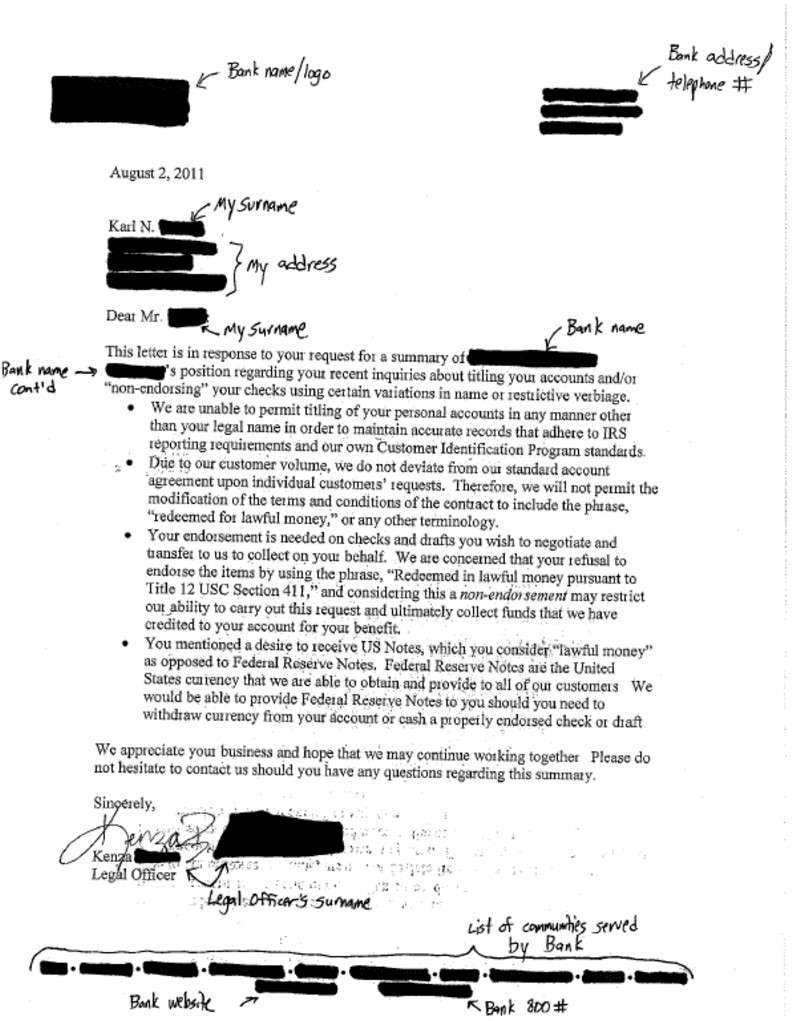
          Your endorsement is needed on checks and drafts you wish to negotiate and transfer to us to collect on your behalf.

          Your initial interpretation is to hear those words their way. Before electronic verification though, one bank would put good faith in another bank. The overdraft protection was a matter of good faith that the customer feared the law, and the fairly stiff penalties that gradually replaced punishment by law. Way back when I dealt with banks I recall a $25 charge per check that could quickly bury me if I wrote four or five checks within a few days time. The trust parameters were different and this is probably written into the tariff or your Signature Card.

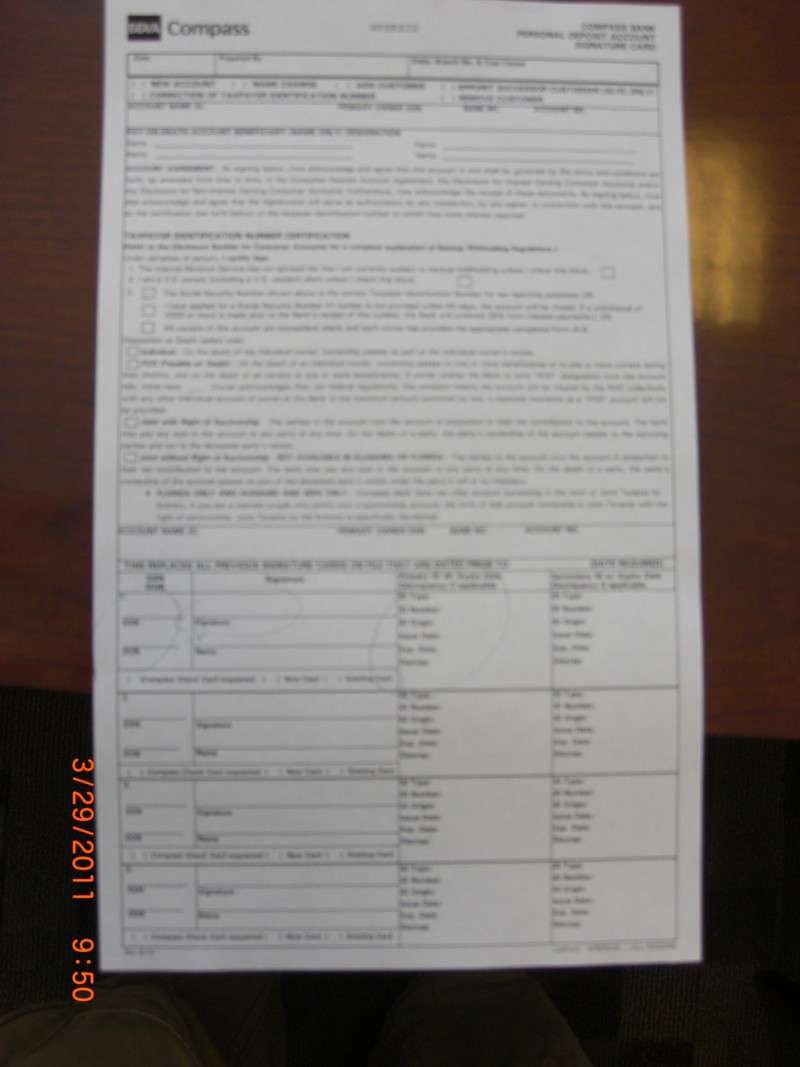
          There is something right there. The Tariff. I forgot about that over the years. I used to edit tariffs for long distance companies. If you want to know how your bank works, ask to read the tariff. After they figure out what is going on, they will bring you a three-ring binder with about a 125-page document in it. It will describe the bank operations thoroughly. If you are a proficient reader and allow for an hour to carefully read, then you will come away with a better understanding of non-endorsement/redemption for sure. It has been so many years that when I was doing some reasearch I called it The Treaty, and the lady at a small Compass Bank branch did not know what I meant. So maybe I will find time - but they don't extend the same courtesy to a prospective customer as an already established one. However I am the kind of guy who will get the entire meeting on audio, and when they get tired of watching me will pull out my camera, starting with the most interesting pages and keep snapping until they get angry and kick me out... [In this linked example I was setting across the desk and my camera battery was low so the auto-focus did not function properly.] I really don't hold a lot of sympathy - even for the most friendly bankers.

          Then I will have something to show you here. That was me, just killing some time Downtown.

          Basically though, the sentence does not apply to paychecks that you just wish to deposit or cash. If you want to deposit on account, they will wait for it to "clear" which will only take seconds if they want to just transfer the funds while you set in your car at the Drive-Thru. If the funds are there at your boss's bank, no problem about handing you the cash too. You did not endorse all that stuff they are talking about - fractional lending, negotiating your instrument etc.

          Simply put - you are not asking them to do all that in the first sentence. You are asking them not to. You are demanding they simply function as a repository for the safety of your lawful money cash. That is what makes the option of going interest-free available to them.

          We are concerned that by refusing to endorse the items by using the phrase, "Redeemed in lawful money pursuant to Title 12 USC Section 411," and considering this a "non-endorsement" may restrict our ability to carry out this request and ultimately collect funds that we have credited to your account for your benefit.


          That is the sentence that reveals a lot about what endorsers approve.

          Your non-endorsement simply allows your bank to keep your money safe. Being fair, they may choose non-interest bearing because they cannot use your funds to "collect funds that we have credited to your account for your benefit." That benefit is of course - the interest you would typically enjoy from having an interest-bearing checking or savings account.

          The Fourth Bullet:

          That is where we start getting too physical. Like I said, understand the metaphysics is more of a verb, a process, than a noun - the physical US notes.

          It looks though, from the closing comment that your bank is willing to do away with you if you continue. They are not telling you they will shut you down. The key sentence is telling you that they are concerned about your demand for lawful money. Think about it. You are not giving them the benefit of fractional lending - all you are doing is making them liable for keeping your money safe. Then reconsider that since you are no longer getting or are deserving of the only benefit beside a safe repository for your cash, interest, that you might consider alternatives to banking at all. In other words start cashing your paychecks at your boss's bank. Buy a safe and a reliable gun (a safe for your gun too if you have children). Get used to not trusting in banks.

          Maybe offer to pay your bank for functioning as your home-safe. But remember that when the Emergency ended in 1976 the one item remaining of significant effect is the ability for the President or Secretary to declare another Bankers' Holiday.


          Look at (subsections too) for yourselves some time.
          Last edited by David Merrill; 08-06-11, 01:33 PM.
          www.lawfulmoneytrust.com
          www.bishopcastle.us
          www.bishopcastle.mobi

          Comment

          • karl nathan
            Junior Member
            • Jul 2011
            • 12

            #20
            Thank you for your in-depth insights David Merrill! I appreciate the time you took to dissect the bank's letter.

            I have made a few changes to my response which I'll be sending to the bank in the near future: Karl Nathan response to bank position - UPDATED.pdf.

            The main changes were made to bullet point #3 clarifying what actions I am taking with the bank.

            I also deleted the last and third to last paragraphs which I had initially included in my first draft: Karl Nathan response to bank DRAFT.pdf. I felt like they were not necessary at this point and would only be a distraction to the counterpoints I have made to the bank.

            I realize the bank will most likely come back with more sophistry based on my response. I am pursuing this as a educational opportunity and nothing more. In the end, I believe I will need to serve the bank with a Notice of my demand for lawful money by way of a certified copy of the Notice, which I would have filed in the USDC, to resolve this matter.

            Comment

            • Hescotoolz
              Junior Member
              • Jul 2011
              • 4

              #21
              I found a bank (sterling bank) that they have no problem with the verbiage on the checks for deposit or withdrawal, I just can't find a bank that will except verbiage other than my signature on the signature card. Can I get around this at all, or is the signature card a must do? Every bank same thing, they shut down when want to add to the sig card. I'm in Medford Oregon, if anyone has done this in Oregon please let me know. I'll move if that's what it takes thx.

              Comment

              • Guest

                #22
                Try Bank of America. I went to BofA's website and did a location search on postal code 97503 (Medford, Oregon) - found several branches in your area.

                Comment

                • Brian
                  Senior Member
                  • Apr 2011
                  • 142

                  #23
                  Originally posted by Hescotoolz View Post
                  I found a bank (sterling bank) that they have no problem with the verbiage on the checks for deposit or withdrawal, I just can't find a bank that will except verbiage other than my signature on the signature card. Can I get around this at all, or is the signature card a must do? Every bank same thing, they shut down when want to add to the sig card. I'm in Medford Oregon, if anyone has done this in Oregon please let me know. I'll move if that's what it takes thx.
                  I opened an account with US bank up here in the PDX area and had no issues with a signing statement. They were a little confused by it but alas allowed it.

                  Comment

                  • Hescotoolz
                    Junior Member
                    • Jul 2011
                    • 4

                    #24
                    BofA was the second bank I tried a couple weeks ago. Same thing the guy wasn't familiar with title 12 so he called to make sure he didn't do something he shouldn't, first thing they told him nothing more than a signature on the signature card. It's getting frustrating

                    Comment

                    • Hescotoolz
                      Junior Member
                      • Jul 2011
                      • 4

                      #25
                      Today the assistant manager of sterling bank had my non interest baring account almost open, asked the manager if she should make a copy of the title 12 document manager told her to call and ask. She didn't even mention signature card to whoever she was talking to they told her nothing more than a signature on the signature card. It's like more people are requesting this and this is the way they are shutting people down

                      Comment

                      • David Merrill
                        Administrator
                        • Mar 2011
                        • 5956

                        #26
                        First item is get out of the conditioning that you walk away, after signing anything - anything! - without your exact copy of it. Ask yourselves how many of you already have a copy of your Signature Card?

                        Put your demand on the Signature Card, and then when they object, strike it through so that it can still be read. Now you Demand is clear on your copy. Your intent to Redeem lawful money with every transaction.

                        The Signature Card as I understand it is only important for electronic transactions, but with ATMs and compulsory electronic paycheck that is a big deal so we need to hash this out correctly. I am beginning to gather that the bankers consider the Signature Card their property; rather than a shared property called Agreement. That might be a good place to start. Begin with tasks (homework) like taking a copy of the Signature Agreement from the bank, take it home.

                        I walked into Compass Bank and grabbed an audio recording. You can see, that for the non-customer/prospective customer it is only to be viewed there, under supervision of Audrey watching me from her desk. Now, I had to shut down the audio to get the photo, but she complained, pulled it away from me and I believe she pretended that I had not snapped the photo. Even so, I did not give my auto-focus time or my battery may have been low. But that would have been precious! - That part of the audio.


                        Speaking for myself though, I get by without a bank. I was just killing time as I recall, making change for my process server.

                        My point is to start chipping down that misperception that agreements are property of the bank. Agreements as I understand them are mutually owned by the participants. So at the least go get a copy of the current Signature Card if you don't already have one. Just ask for a copy of your Signature Card.

                        If you have an hour though, ask to see the bank's tariff.

                        Please take an audio recording of this. If you want, maybe you can sanitize it with an audio editor so you can amplify weak voices. Let's hear it here. The tariff is a three-ring notebook with about 100 pages in it. It describes in detail every operation of your bank. It is the bank manager/president's instruction manual. So if you don't mind looking a little wierd, talk to yourself - read to yourself. That way we get an idea of what is in the tariff. After a while ask the manager to please show you where you cannot add anything to the Signature Card signature? Then when you have a bunch of intel for us here, pull out your camera and start getting photos for us, until they kick you out.

                        That is how I would do it. In fact, next time I have the time...


                        Last edited by David Merrill; 08-13-11, 10:32 AM.
                        www.lawfulmoneytrust.com
                        www.bishopcastle.us
                        www.bishopcastle.mobi

                        Comment

                        • Guest

                          #27
                          Originally posted by Hescotoolz View Post
                          BofA was the second bank I tried a couple weeks ago. Same thing the guy wasn't familiar with title 12 so he called to make sure he didn't do something he shouldn't, first thing they told him nothing more than a signature on the signature card. It's getting frustrating
                          Call the BofA branch at which I opened an account. The phone number is 312-464-0701. Ask for La Joyce. She is the personal banker that was given the green light by BofA legal department to accept my amendment to the signature card. Request that she have whatever BofA attorney she consulted to contact the branch that you visited in your area.
                          I did the same at Cole Talyor bank. The 47th street branch, after accepting the paycheck with the verbiage for several weeks, suddenly refused. So I went to the downtown branch. At this branch the manager pulled me to the side and informed me that he will consult the legal department before honoring the check, and that I should follow up with him after several days. Well, I did, and the manager said (via voicemail and email) that the verbiage is okay. I asked this manager to inform the 47th street branch of this so that I may continue to cash the checks there. My subsequent visit to 47th proved to be successful, although the manager acted all "hoidy-toidy" - as if he was insulted that I "went over their heads."

                          As a matter of fact, when I presented the restricted check to the teller, she initially refused. Then I asked her to consult her manager as this matter had been resolved by Cole Taylor's legal department. She then replied, "Oh yeah. We had a meeting about this. Let me go get my manager." The manager returned, performed an "override" - and all the while wouldn't even look me in the eye.
                          My point is that one branch bank may help another branch to overcome ignorance.
                          Back to BofA. Well, all I can say is that I was clear to specify what I wanted - La Joyce took notes - and faxed the notes over to the legal folks.


                          I expressed the following to LaJoyce:
                          1. I want to open a non-interest bearing checking account.
                          2. It is my intention to only handle lawful money on this account.
                          3. It is my intent to NOT handle any form of credit on this account.
                          4. I absolutely do not and will not open a savings account (or any other type of interest bearing account).
                          5. On anything to which I put my signature, I want to express my intent.
                          When she asked just how I would express my intent, that's when I pulled out my ink stamper. I stamped the verbiage on a blank sheet of printer paper that she provided. It was on that same sheet of paper that she took notes on whatever I spoke.

                          I did explain to her reality of lawful money vs private credit, but I did that only because she was genuinely interested. But I did convince her to contact the legal department rather than relying on the ignorance of the branch manager.

                          I really appreciate La Joyce.
                          Last edited by David Merrill; 07-02-15, 01:19 AM.

                          Comment

                          • karl nathan
                            Junior Member
                            • Jul 2011
                            • 12

                            #28
                            To recap...I was waiting to respond to the letter I received from my bank: Bank's position.pdf. I was waiting for...

                            On 8/16 RThomas created a new thread "A regular deposit of lawful money." That evening I went to my public library and investigated the terminology used by RThomas. I must say thank you to RThomas for sharing the knowledge about regular vs irregular deposits!

                            On 8/19 I mailed my response to my bank: Karl Nathan response to Bank's Position.pdf. I received the bank's response to my letter the following week:Bank unchanged position.pdf

                            Also on 8/19 the FDIC mailed this letter to me which I received the following week: FDIC response.pdf, which was in response to my initial inquiry: FDIC and State banking regulator letter.pdf

                            I called and spoke with the FDIC case manager who was investigating my 'complaint' (their word not mine) and he stated that a bank can not refuse my cash to be redeemed in lawful money, but the bank can refuse to accept my negotiable instrument, my check with the demand verbiage instead of my indorsement, as it is not redeemable in lawful money on demand as it is not a FRN.

                            The bank is required to respond to the FDIC within several weeks. The FDIC will then write me a letter responding to my inquiry.

                            Comment

                            • David Merrill
                              Administrator
                              • Mar 2011
                              • 5956

                              #29
                              Originally posted by karl nathan View Post
                              Thank you for your in-depth insights David Merrill! I appreciate the time you took to dissect the bank's letter.

                              I have made a few changes to my response which I'll be sending to the bank in the near future: [ATTACH]613[/ATTACH].

                              The main changes were made to bullet point #3 clarifying what actions I am taking with the bank.

                              I also deleted the last and third to last paragraphs which I had initially included in my first draft: [ATTACH]614[/ATTACH]. I felt like they were not necessary at this point and would only be a distraction to the counterpoints I have made to the bank.

                              I realize the bank will most likely come back with more sophistry based on my response. I am pursuing this as a educational opportunity and nothing more. In the end, I believe I will need to serve the bank with a Notice of my demand for lawful money by way of a certified copy of the Notice, which I would have filed in the USDC, to resolve this matter.

                              Thank you for sharing this with us!

                              That letter looks great. Include the August 2nd letter from them so they can refresh point-by-point easily. Also if you want to bare some teeth about that last paragraph find some appropriate federal crimes to fill in with this Criminal Complaint Form
                              www.lawfulmoneytrust.com
                              www.bishopcastle.us
                              www.bishopcastle.mobi

                              Comment

                              • Chex
                                Senior Member
                                • May 2011
                                • 1032

                                #30
                                Pete: I have an account officer asking why can't we just cross out the name of the individual that will no longer be on the account instead of re-doing the account signature card? If we have to re-do the signature card where in the regulation that states this is what is required?

                                Tilly: We require individual accounts and business accounts that remove a signer from an account to re-sign a "revised" account signature card with the current signers and a revised date. Can anyone help me with "we are only going to do this if it is a regulation" statement???

                                Pete: There is no regulation, but you might want to suggest that he get the OK from your attorney first. I can guarantee that your attorney will have either a "deer in the headlights" or a "you gotta be kidding me, right" look on his face once he presents his question - take your choice. How does someone - anyone - cross a name off a contract act to nullify a contract that has already been executed?

                                Tilly: Thanks that was what I was thinking - more of a contract situation instead of a regulation.

                                Burt: We have a procedure and policy for this type of situation; and we require new signature cards for any changes. Crossing names out or changing information on the initial or original signature card can appear to be an alteration, whereas a new signature card acts as an official amendment or update to the account titling.

                                Pete: Too many court cases involving account ownership have embarrassed bankers by revealing shortcuts like crossing out or adding names to old signatures cards. Not only does it appear sloppy; it also doesn't provide a court with any assurance that the bank is careful about contracts.
                                "And if I could I surely would Stand on the rock that Moses stood"

                                Comment

                                Working...
                                X