

In the name of Allah, Most Gracious and Most Merciful
From Muhammad, the Messenger of Allah, to Hiraql, the Emperor of the Romans.
Peace be on him, who follows the right path.
After this, I invite you to the fold of Islam. Therefore, if you desire security, accept Islam. If you accept Islam, Allah shall reward you double and if you refuse to do so, the responsibility for the transgression of the entire nation, shall be yours.
O people of the Book, come to the word that is common between us, that we should worship none other than Allah, should not ascribe any partner to Him, and that none of us should take their fellows as Lords other than Allah.
If you deny this, you must know that we believe in Oneness of Allah, in all circumstances.
Seal: Allah's Prophet Muhammad
From Muhammad, the Messenger of Allah, to Hiraql, the Emperor of the Romans.
Peace be on him, who follows the right path.
After this, I invite you to the fold of Islam. Therefore, if you desire security, accept Islam. If you accept Islam, Allah shall reward you double and if you refuse to do so, the responsibility for the transgression of the entire nation, shall be yours.
O people of the Book, come to the word that is common between us, that we should worship none other than Allah, should not ascribe any partner to Him, and that none of us should take their fellows as Lords other than Allah.
If you deny this, you must know that we believe in Oneness of Allah, in all circumstances.
Seal: Allah's Prophet Muhammad
The practice of inviting non-Muslim nations to join Islam or pay the Jizyah prior to engaging in offensive Jihad was first initiated by the Prophet Muhammad. His example was then followed by the Rightly-Guided Caliphs and the leaders of Islamic empires, codified within the Islamic Shari'ah[1] and is continued today by various Islamic leaders and terrorist organizations.
The Requerimiento was a speech read aloud in Spanish or Latin when Spaniards encountered a group of native peoples. The document presented an ultimatum for natives to submit to the superiority of Christianity and the political authority of Spain, or be warred upon. The wording of the document resembles the demands for submission characteristic of the Islamic jihad or holy war.
The above image from a Roman Catholic website which mentions the idea of Mary being the Ark of the Covenant
A few centuries before Heraclius was Elagabalus:
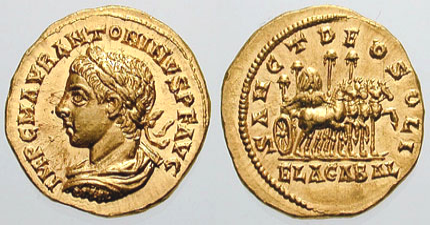
A Roman aureus depicting Elagabalus. The reverse reads Sanct Deo Soli Elagabal (To the Holy Sun God Elagabal), and depicts a four-horse, gold chariot carrying the holy stone of the Emesa temple.
Before constructing a temple in dedication to Elagabal, Elagabalus placed the meteorite of Elagabal next to the throne of Jupiter at the temple of Jupiter Optimus Maximus.
He caused further discontent when he himself married the Vestal Virgin Aquilia Severa, claiming the marriage would produce "godlike children".[37] This was a flagrant breach of Roman law and tradition, which held that any Vestal found to have engaged in sexual intercourse was to be buried alive.[38]
A lavish temple called the Elagabalium was built on the east face of the Palatine Hill to house Elagabal, who was represented by a black conical meteorite from Emesa.[21] Herodian wrote "this stone is worshipped as though it were sent from heaven; on it there are some small projecting pieces and markings that are pointed out, which the people would like to believe are a rough picture of the sun, because this is how they see them".
He caused further discontent when he himself married the Vestal Virgin Aquilia Severa, claiming the marriage would produce "godlike children".[37] This was a flagrant breach of Roman law and tradition, which held that any Vestal found to have engaged in sexual intercourse was to be buried alive.[38]
A lavish temple called the Elagabalium was built on the east face of the Palatine Hill to house Elagabal, who was represented by a black conical meteorite from Emesa.[21] Herodian wrote "this stone is worshipped as though it were sent from heaven; on it there are some small projecting pieces and markings that are pointed out, which the people would like to believe are a rough picture of the sun, because this is how they see them".
[ATTACH=CONFIG]1435[/ATTACH]
Shrine of the sacred stone in Mecca, formerly dedicated to the pre-Islamic Triple Goddess Manat, Al-Lat (Allah), and Al-Uzza, the 'Old Woman' worshipped by Mohammed's tribesmen the Koreshites. The stone was also called Kubaba, Kuba or Kube, and has been linked with the name of Cybele (Kybela), the Great Mother of the Gods. The stone bore the emblem of theyoni, like the Black Stone worshipped by votaries of Artemis. Now it is regarded as the holy center of patriarchal Islam, and its feminine symbolism has been lost, though priests of the Kaaba are still known as Sons of the Old Woman.
Shrine of the sacred stone in Mecca, formerly dedicated to the pre-Islamic Triple Goddess Manat, Al-Lat (Allah), and Al-Uzza, the 'Old Woman' worshipped by Mohammed's tribesmen the Koreshites. The stone was also called Kubaba, Kuba or Kube, and has been linked with the name of Cybele (Kybela), the Great Mother of the Gods. The stone bore the emblem of theyoni, like the Black Stone worshipped by votaries of Artemis. Now it is regarded as the holy center of patriarchal Islam, and its feminine symbolism has been lost, though priests of the Kaaba are still known as Sons of the Old Woman.
In order to become the high priest of his new religion, Elagabalus had himself circumcised.[35] He forced senators to watch while he danced around the altar of Deus Sol Invictus to the accompaniment of drums and cymbals.[21] Each summer solstice he held a festival dedicated to the god, which became popular with the masses because of the free food distributed on such occasions.[36] During this festival, Elagabalus placed the Emesa stone on a chariot adorned with gold and jewels, which he paraded through the city:
Attached Files