Exactly what does the IRS agent think?

Collapse
X
 
  • Time
  • Show
Clear All
new posts

  • David Merrill
    replied
    Originally posted by Chex View Post
    Chex;

    Thank you again - the brain trust offers insight too about how the IRS agent/attorneys think!


    Crosstalk: Did anyone else besides me notice the glaring typo in the closing sentence of this document?
    We now agree with the court that adding the words "under protest" without modifying the words of the jurat does not cast doubt on the validity of the jurat and, accordingly, does invalidate the document as a return.


    The last sentence says the opposite of the court opinion being talked about in the IRS memorandum - instructing the IRS agents to consider the Return invalid. This might be sleezy attorney artistry. But writing about it here brings some insight for the brain trust! (Echo chamber return.)

    The IRS attorneys may be instructing the IRS agents that while they cannot charge a frivolous fine - when the taxpayer declares the signature under protest, the Return is indeed invalid because it is "unvoluntary".

    Furthermore notice how the IRS attorneys filed an immediate Notice of Appeal into the Second Circuit. The USCA was notified - meaning the United States Code Annotated and quickly the IRS decided they did not want the justices opining about this at all so it was withdrawn.

    Chex;

    Please show us your search engine path leading you to this memorandum. Are there other memos that I am missing for this thread?
    Attached Files

    Leave a comment:


  • David Merrill
    replied
    My theory of the week is that swearing subjegates one to government - which government can take on many different forms in life. It is the means to become a government servant. Jesus was awarded upon birth (gold) funds for the family tomb, starting with his generation and also a scholarship, giving him access to all the mystery schools in Egypt, Israel and Babylon. Jesus never, in other words swore in to the government of any Lodge.


    There is more to this though. There was a mountain man living in leathers (in exile). The King of Israel had been in exile for over twenty years - his name was Archelaus HEROD. The HEROD who took John's head (after John spoke out against him as ruler) was Antipater HEROD and was never King - but remained Tetrarch. There was another brother Philip HEROD but that was in another province so he never really got into the Bible Story. Archelaus was exiled in about 6 AD or when Jesus was about ten.

    Upon Archelaus dying the title had a Vacancy and finally Jesus took an oath of office. The dunking in the Jordan really has very little explanation so please accept that Planet Merrill abhors a void. This fits so nicely.

    However the Gospels carry two firm admonishions against swearing at all. - Not by heaven or earth.

    When you are sworn in even to testify are you not giving that Lodge permission to punish you for perjury? Does this bring you into position as a party in interest to the court? How about the 1040 Form? What about anything you swear to?
    Last edited by David Merrill; 02-09-13, 05:06 AM.

    Leave a comment:


  • allodial
    replied
    Why must the form be made under penalties of perjury? Why cant it just be a declaration. If the information matches the record what is the need to 'ceremonialize' it to such an extent? Is it because you have to 'risk' something to make the return 'valid'?

    Last edited by allodial; 02-09-13, 01:40 AM.

    Leave a comment:


  • David Merrill
    replied
    Excellent find! Thank you.

    Leave a comment:


  • Chex
    replied
    Recommendation: Acquiescence.

    Leave a comment:


  • shikamaru
    replied
    Originally posted by BAMAJiPS View Post
    Am I reading this right?? Do my eyes deceive me??? UNITED STATES OF AMERICA is a foreign entity that operates in admiralty court under the guise of the legitimate government of these united states of America? Do I have that right?
    The United States of America is an association composed of States only.
    The government of the United States is a public corporation.
    The government of the United States is private international law.

    Government of the United States is foreign to the several (individual States).

    Government of the United States operates on Roman Civil Law.
    The law of the District of Columbia is Lex Fori.

    Leave a comment:


  • David Merrill
    replied
    What fails to be typical about me (apparently) is that my perceptions and conclusions change in time by allowing my understanding of Rules of Evidence to process new information (once verified) into new perceptions. In other words please take note of the date I wrote that paper. It got Ron's money and recently I learned that the entire action seizing all those accounts was completely reversed, I think with Ron being about the only one who got any money back. That does not mean that everything I wrote in the paper is factual.

    Many of the assertions might just be my perceptions at the time. Ron being restored of his life savings does not prove that all my perceptions were factual.

    Leave a comment:


  • BAMAJiPS
    replied
    Am I reading this right?? Do my eyes deceive me??? UNITED STATES OF AMERICA is a foreign entity that operates in admiralty court under the guise of the legitimate government of these united states of America? Do I have that right?

    Leave a comment:


  • LearnTheLaw
    replied
    Originally posted by David Merrill View Post
    The insideous part of all that is the US Supreme Court has ruled there to be three viable definitions for the United States.

    Importing RIVERA's work here might be best with this warning, for what it is worth. I have not seen any results or delivery - but then because he is an attorney (or was before he was disbarred?) and three definitions for the US, I have not spent any time looking at his school and lesson plan.

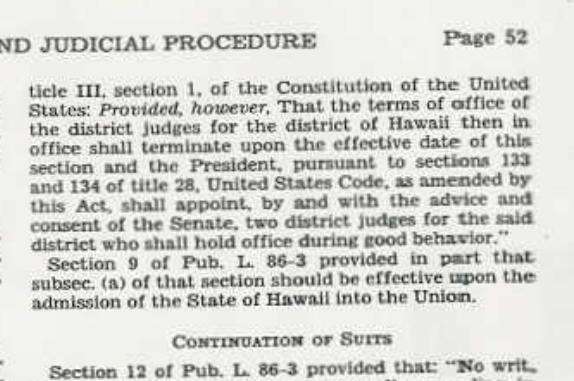
    When he started telling people that Hawaii had Article III courts I inquired by email if they had ever terminated the Article I employees. He went silent and never answered, except that he did seem to quit preaching it...


    If he had been courteous enough to email me back with some kind of acknowledgement I might be more inclined to follow his work.


    Chapter 4:*
    The Three United States


    By 1945, the year of the first nuclear war on planet Earth, the U.S. Supreme Court had come to dispute Marshall's singular definition, but most people were too distracted to notice. The high Court confirmed that the term "United States" can and does mean three completely different things, depending on the context:


    The term "United States" may be used in any one of several senses. [1] It may be merely the name of a sovereign* occupying the position analogous to that of other sovereigns in the family of nations. [2] It may designate the territory over which the sovereignty of the United States** extends, or [3] it may be the collective name of the states*** which are united by and under the Constitution.

    [Hooven & Allison Co. v. Evatt, 324 U.S. 652 (1945)]
    [brackets, numbers and emphasis added]


    This same Court authority is cited by Black's Law Dictionary, Sixth Edition, in its definition of "United States":

    United States. This term has several meanings. [1] It may be merely the name of a sovereign occupying the position analogous to that of other sovereigns in family of nations, [2] it may designate territory over which sovereignty of United States extends, or [3] it may be collective name of the states which are united by and under the Constitution. Hooven & Allison Co. v. Evatt, U.S. Ohio, 324 U.S. 652, 65 S.Ct. 870, 880, 89 L.Ed. 1252.

    [brackets, numbers and emphasis added]

    In the first sense, the term "United States*" can refer to the nation, or the American empire, as Justice Marshall called it. The "United States*" is one member of the United Nations. When you are traveling overseas, you would go to the U.S.* embassy for help with passports and the like. In this instance, you would come under the jurisdiction of the President, through his agents in the U.S.* State Department, where "U.S.*" refers to the sovereign nation. The Informer summarizes Citizenship in this "United States*" as follows:

    1. I am a Citizen of the United States* like you are a Citizen of China. Here you have defined yourself as a National from a Nation with regard to another Nation. It is perfectly OK to call yourself a "Citizen of the United States*." This is what everybody thinks the tax statutes are inferring. But notice the capital "C" in Citizen and where it is placed. Please go back to basic English.
    [Which One Are You?, page 11]
    [emphasis added]


    Secondly, the term "United States**" can also refer to "the federal zone", which is a separate nation-state over which the Congress has exclusive legislative jurisdiction. (See Appendix Y for a brief history describing how this second meaning evolved.) In this sense, the term "United States**" is a singular phrase. It would be proper, for example, to say, "The United States** is ..." or "Its jurisdiction is ..." and so on. The Informer describes citizenship in this United States** as follows:


    2. I am a United States** citizen. Here you have defined yourself as a person residing in the District of Columbia, one of its Territories, or Federal enclaves (area within a Union State) or living abroad, which could be in one of the States of the Union or a foreign country. Therefore you are possessed by the entity United States** (Congress) because citizen is small case. Again go back to basic english [sic]. This is the "United States**" the tax statutes are referring to. Unless stated otherwise, such as 26 USC 6103(b)(5).
    [Which One Are You?, page 11]
    [emphasis added]


    Thirdly, the term "United States***" can refer to the 50 sovereign States which are united by and under the Constitution for the United States of America. In this third sense, the term "United States***" does not include the federal zone, because the Congress does not have exclusive legislative authority over any of the 50 sovereign States of the Union. In this sense, the term "United States***" is a plural, collective term. It would be proper therefore to say, "These United States***" or "The United States*** are ..." and so on. The Informer completes the trio by describing Citizenship in these "United States***" as follows:

    3. I am a Citizen of these United States***. Here you have defined yourself as a Citizen of all the 50 States united by and under the Constitution. You are not possessed by the Congress (United States**). In this way you have a national domicile, not a State or United States** domicile and are not subject to any instrumentality or subdivision of corporate governmental entities.
    [Which One Are You?, pages 11-12]
    [emphasis added]


    Author and scholar Lori Jacques summarizes these three separate governmental jurisdictions in the same sequence, as follows:

    It is noticeable that Possessions of the United States** and sovereign states of the United States*** of America are NOT joined under the title of "United States." The president represents the sovereign United States* in foreign affairs through treaties, Congress represents the sovereign United States** in Territories and Possessions with Rules and Regulations, and the state citizens are the sovereignty of the United States*** united by and under the Constitution .... After becoming familiar with these historical facts, it becomes clear that in the Internal Revenue Code, Section 7701(a)(9), the term "United States**" is defined in the second of these senses as stated by the Supreme Court: it designates the territory over which the sovereignty of the United States** extends.

    [A Ticket to Liberty, Nov. 1990, pages 22-23]
    [emphasis added, italics in original]


    You should explore this site at some point:

    Leave a comment:


  • David Merrill
    replied
    Originally posted by stoneFree View Post
    Hmm, I don't see any Ed RIVERA work here. I do see Chex has linked to Edwin VIEIRA, a different attorney altogether.
    Ooops! My bad!

    I wonder how many times I have done that?

    Leave a comment:


  • stoneFree
    Guest replied
    Hmm, I don't see any Ed RIVERA work here. I do see Chex has linked to Edwin VIEIRA, a different attorney altogether.

    Leave a comment:


  • David Merrill
    replied
    That is preaching to the choir. Every suitor who has filed a Libel of Review inquires upon judge appointment, Is this an Article III Judge? The clerk's affirmation to a falsity is where the new suitor is understanding his or her authority to sign and seal the resulting judgment.

    I think that you understood my point about acknowledging my question about Hawaii.

    Leave a comment:


  • Chex
    replied
    Do your own due diligence.


    Q: Who appoints federal judges?
    Supreme Court justices, court of appeals judges, and district court judges are nominated by the President and confirmed by the United States Senate, as stated in the Constitution. The names of potential nominees are often recommended by senators or sometimes by members of the House who are of the President's political party. The Senate Judiciary Committee typically conducts confirmation hearings for each nominee. Article III of the Constitution states that these judicial officers are appointed for a life term. The federal Judiciary, the Judicial Conference of the United States, and the Administrative Office of the U.S. Courts play no role in the nomination and confirmation process. http://www.uscourts.gov/Common/FAQS.aspx

    Our Founding Fathers understood the need for an independent Judiciary, which was created under Article III of the United States Constitution. The Judicial Branch is one of the three separate and distinct branches of the federal government. The other two are the legislative and executive branches. http://www.uscourts.gov/FederalCourts.aspx

    The Constitution describes what cases may be decided in the federal courts. Congress may and has determined that some of these cases also may be tried in state courts, giving federal and state courts concurrent jurisdiction.

    Congress has provided that suits between citizens of different states may be heard in the federal courts or the state courts, but they may be heard in the federal courts only if the amount in controversy exceeds $50,000.

    Congress also has provided that maritime cases and suits against consuls may be tried only in the federal courts. When a state court decides a case involving federal law, it in a sense acts as a federal court, and its decisions on federal law may be reviewed by the U.S. Supreme Court. http://www.lectlaw.com/def/a149.htm

    Before a federal court can hear a case, or "exercise its jurisdiction," certain conditions must be met. First, under the Constitution, federal courts exercise only "judicial" powers. This means that federal judges may interpret the law only through the resolution of actual legal disputes, referred to in Article III of the Constitution as "Cases or Controversies." A court cannot attempt to correct a problem on its own initiative, or to answer a hypothetical legal question.

    Second, assuming there is an actual case or controversy, the plaintiff in a federal lawsuit also must have legal "standing" to ask the court for a decision. That means the plaintiff must have been aggrieved, or legally harmed in some way, by the defendant. http://www.uscourts.gov/FederalCourt...isdiction.aspxrule of expediency is applicable?

    After all, the practical reason why, when the power is once in the hands of the people, a majority are permitted, and for a long period continue, to rule is not because they are most likely to be in the right, nor because this seems fairest to the minority, but because they are physically the strongest.

    I think that we should be men first, and subjects afterward. It is not desirable to cultivate a respect for the law, so much as for the right. The only obligation which I have a right to assume is to do at any time what I think right. It is truly enough said that a corporation has no conscience; but a corporation on conscientious men is a corporation with a conscience.

    To speak practically and as a citizen, unlike those who call themselves no-government men, I ask for, not at once no government, but at once a better government. Let every man make known what kind of government would command his respect, and that will be one step toward obtaining it.

    You can find a whole slew of Article III federal judges
    Last edited by Chex; 01-02-13, 03:40 PM.

    Leave a comment:


  • David Merrill
    replied
    The insideous part of all that is the US Supreme Court has ruled there to be three viable definitions for the United States.

    Importing RIVERA's work here might be best with this warning, for what it is worth. I have not seen any results or delivery - but then because he is an attorney (or was before he was disbarred?) and three definitions for the US, I have not spent any time looking at his school and lesson plan.

    When he started telling people that Hawaii had Article III courts I inquired by email if they had ever terminated the Article I employees. He went silent and never answered, except that he did seem to quit preaching it...


    If he had been courteous enough to email me back with some kind of acknowledgement I might be more inclined to follow his work.

    Leave a comment:


  • Chex
    replied
    It coincidental that you mentioned the FDIC in this post. I was looking to see what the real differences were in Public and private sectors.

    I found this one from Canada. If personal information is collected and an organization finds a new purpose for it, unless the new purpose is required by law, an organization cannot use that personal information for another purpose without consent. http://www.privacysense.net/10-priva...ying-purposes/

    The 10 Privacy Principles of PIPEDA, also known as the 10 Fair Information Principles, come from a national standard called the CSA Model Code for the Protection of Personal Information. http://www.privacysense.net/10-priva...les-of-pipeda/

    So did the United States have to say?

    This is the GAO opinion: http://www.gao.gov/products/GAO-06-674

    Personal Information required by law. IBM said In addition, we reserve the right to disclose your personal information as required by law and when we believe that disclosure is necessary to protect our rights, ...where then are my rights?

    Linkhttp://www.law.cornell.edu/uscode/text/5/552ahttp://www.law.cornell.edu/uscode/text/5/552#ehttp://www.law.cornell.edu/uscode/text/5/552a#FN-1REF

    But you have this term person again and I have read all over the internet that I am not a person.
    So what exactly who is this person they say without respect to persons?
    http://www.supremecourt.gov/about/oa...ffice2009.aspx and
    http://www.law.cornell.edu/uscode/text/28/453 except for here
    http://www.law.cornell.edu/constitution/articleii for this


    Note that there is no such prohibition against Congress, or any delegated power to make anything legal tender. Congress was originally understood to have no power to make anything legal tender outside of federal territories, under Art. I Sec. 8 Cl. 17and Art. IV Sec. 3 Cl. 2, but in 1868 a Supreme Court packed by Pres. Ulysses S. Grant, in the Legal Tender Cases, allowed Congress to make paper currency issued by the U.S. Treasury, backed by gold, legal tender on state territory, a precedent that remains controversial to this day, when courts allow paper currency not backed by anything to be considered "legal tender".

    John L. Lewis, Plaintiff/Appellant, v. United States of America, Defendant/Appellee.


    So why is it that commerce is unfair to this "PERSON"?
    (a) Declaration of unlawfulness; power to prohibit unfair practices; inapplicability to foreign trade
    (1) Unfair methods of competition in or affecting commerce, and unfair or deceptive acts or practices in or affecting commerce, are hereby declared unlawful. http://www.law.cornell.edu/uscode/text/15/45
    (2)The Commission is hereby empowered and directed to prevent persons, partnerships, or corporations, except banks, savings and loan institutions described in section 57a(f)(3) of this title, Federal credit unions described in section 57a(f)(4) of this title, common carriers subject to the Acts to regulate commerce, air carriers and foreign air carriers subject to part A of subtitle VII of title 49, and persons, partnerships, or corporations insofar as they are subject to the Packers and Stockyards Act, 1921, as amended http://www.law.cornell.edu/uscode/text/7/182

    Vieira Delivershttp://www.fedstats.gov/agencies/http://www.govtrack.us/start

    So now that I am off topic again because I was looking to be in the private and go into the courts as private looks like I have to find the protocol to do it.

    Not only that but this is what I am talking about: http://le.utah.gov/~2012/bills/hbillint/hb0157.pdf
    Last edited by Chex; 01-02-13, 12:15 AM.

    Leave a comment:

Working...